

Repair or Replace? The 2026 Miami Homeowner’s Guide to Failing AC Units

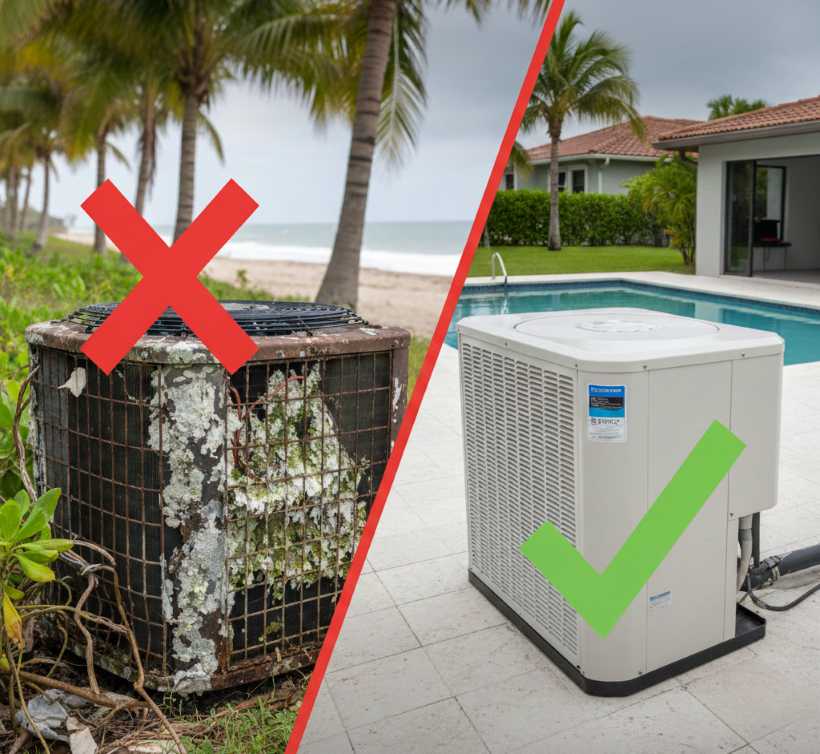
In Miami, an air conditioner isn’t just an appliance; it’s a life-support system. When it fails, you don’t have days to research, you have hours before the indoor humidity turns your home into a petri dish. But in 2026, the decision to “just fix it” is more complicated than ever. Between the new SEER2 efficiency mandates and the total industry shift toward A2L refrigerants, the wrong choice could lock you into a “money pit” system for the next decade.
Whether you are battling the salt-air of the Gables or the extreme humidity of Kendall, here is the definitive guide to deciding if your AC is worth the save.
1. The “Rule of 5,000” for 2026
Traditional advice says to replace an AC every 10–12 years. In Miami, that’s a fairy tale. Our units run 2,500+ hours a year, double the national average. Instead of age alone, use the Rule of 5,000:
(Age of Unit) x (Cost of Repair) = Your Decision Number
- Below 5,000: It’s likely worth the repair.
- Above 5,000: You are throwing “good money after bad.” Replace it.
Example: You have a 9-year-old unit in Doral. The blower motor died, and the quote is $650. 9 x 650 = 5,850. Your unit has entered the “Danger Zone.” It is time to look at replacement options.
2. The Geographic Reality: Coastal vs. Inland Maintenance
Miami isn’t a monolith. Your zip code determines what is killing your AC.
The Coastal Zone (0–5 Miles from Ocean)
Areas: South Beach, Brickell, Coral Gables, Key Biscayne. The villain here is Salt-Air Corrosion. Salt particles act like sandpaper on your aluminum fins. Once that “white rust” appears, your unit loses its ability to transfer heat.
- The 2026 Tip: If you’re replacing a coastal unit, ask about phenolic coatings or “Sea Coast” models. Standard units will fail 30% faster in these zones.
The Inland Zone (5+ Miles Inland)
Areas: Kendall, Doral, Hialeah, West Miami. Inland units die from Bio-Growth and “Slugging.” High humidity levels (regularly 80%+) create a slime in your primary drain line. If your float switch fails, that water backs up into your air handler, often causing thousands in ceiling damage before you even notice.
- The 2026 Tip: Monthly vinegar flushes are no longer optional. Inland units should have a secondary drain pan and an active “EZ-Trap” for easy cleaning.
3. The “Hidden” Costs of 2026: R-410A vs. A2L
This is where most Miami homeowners get blindsided. As of 2026, the EPA has fully transitioned the industry to Low-GWP (Global Warming Potential) refrigerants like R-454B and R-32.
- The R-410A Trap: If your current unit was installed before 2025, it likely uses R-410A. Production of this gas has been slashed. A simple “recharge” for a leak that cost $400 two years ago can now run $800–$1,200.
- The A2L Advantage: New 2026 systems are up to 12% more efficient and use refrigerants that are cheaper to manufacture long-term.
If your tech says you have a “refrigerant leak” in an 8-year-old system, do not pay for a refill. You are essentially paying for a tank of gas in a car with a hole in the fuel line.
4. Frequently Asked Questions
How much does a new AC cost in Miami in 2026?
Expect to pay between $6,500 and $13,000 for a full residential replacement. Factors include the SEER2 rating (efficiency) and whether you need a “Leak Detection System” (now mandatory on new A2L units).
Why is my FPL bill so high even with the AC on?
If your unit is struggling with Miami’s humidity, it “short-cycles.” It turns on and off constantly but never stays on long enough to actually pull the moisture out of the air. This spikes your electricity usage while leaving your home feeling “sticky.”
Is a 10-year-old AC considered “old” in Florida?
Yes. Due to our “Always On” climate, a 10-year-old unit in Florida has the equivalent wear and tear of a 20-year-old unit in New York.
What is the best SEER2 rating for Miami?
While the federal minimum has risen, we recommend 16 to 18 SEER2 for Miami. Going higher (20+) often has a “diminishing return” unless you plan on staying in the home for more than 15 years.
5. The Verdict: When to Pull the Trigger
Replace if:
- Your unit uses R-410A and has a coil leak.
- Your FPL bill has increased by 20% year-over-year with no change in habits.
- You’ve had more than two “no-cool” service calls in 12 months.
Repair if:
- The unit is under 6 years old (still under parts warranty).
- The issue is a simple electrical component (capacitor or contactor).
- You have a verified maintenance history with no previous leaks.
Need a Second Opinion?
Don’t get pressured into a $12,000 sale by a tech on commission. Download our “Miami AC Survival Checklist” below or text us a photo of your unit’s model plate. We’ll tell you exactly how old it is and if it’s on the “R-410A Hit List.”
